
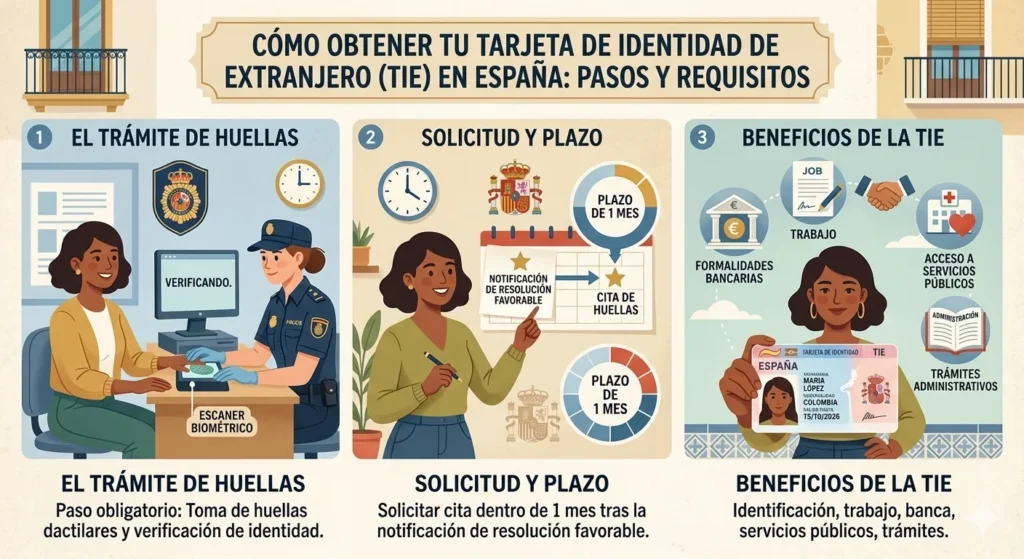
The fingerprint appointment for the TIE in Spain is a mandatory administrative step for foreign nationals who have been granted a residence permit or long-term stay authorisation.
The Foreigner Identity Card (TIE – Tarjeta de Identidad de Extranjero) is the physical document that certifies the lawful administrative status of foreign nationals in Spain, as well as their type of residence authorisation, identity and period of validity.
Once a residence authorisation has been granted, the foreign national must request a fingerprint appointment (cita de huellas) in order to proceed with the taking of fingerprints and the issuance of the TIE card.
Legal framework governing the TIE in Spain
The procedure for issuing the Foreigner Identity Card in Spain is primarily regulated by the following legislation:
- Organic Law 4/2000 of 11 January, on the rights and freedoms of foreign nationals in Spain and their social integration.
- Royal Decree 1155/2024 of 19 November, approving the Regulation implementing Organic Law 4/2000.
These legal provisions establish the requirements, administrative procedures and documentation applicable to foreign nationals residing in Spain.
What is the fingerprint appointment for the TIE?
The fingerprint appointment in Spanish immigration procedures is the administrative step whereby the foreign national must attend in person at the National Police Office in order to complete the process required for the issuance of the Foreigner Identity Card.
During this appointment, the authorities will carry out:
- The collection of fingerprints.
- Verification of the applicant’s identity.
- Verification of the favourable residence decision authorising the issuance of the card.
- The formal application for the Foreigner Identity Card (TIE).This step is essential for the production of the physical residence card.
Time limit to apply for the TIE in Spain
Under Spanish immigration regulations, foreign nationals must request the fingerprint appointment for the TIE within one month from the date of notification of the favourable decision granting residence or long-term stay authorisation.
Failure to comply with this time limit may lead to administrative complications or delays in the issuance of the residence card.
Required documents for the fingerprint appointment
When attending the fingerprint appointment for the TIE, applicants are generally required to submit the following documentation:
- A valid passport.
- The favourable residence authorisation decision.
- The TIE application form (Form EX-17).
- Proof of payment of the administrative fee (Form 790, Code 012).
- A recent passport-size colour photograph with a white background.
- Certificate of municipal registration (empadronamiento), where required.
Additional documentation may be requested depending on the applicant’s specific immigration status.
Where to request the fingerprint appointment for the TIE
The TIE fingerprint appointment in Spain must be booked in advance through the official electronic portal of the Spanish public administration.
The fingerprints are taken in person at the National Police Station corresponding to
the applicant’s place of residence.
Processing time for the TIE card
Once the fingerprinting process has been completed at the National Police Office, the Foreigner Identity Card is usually available for collection within approximately 30 days.
The card must be collected in person by the holder.
Importance of the Foreigner Identity Card in Spain
The TIE card in Spain is the official document that proves the legal immigration status of a foreign national residing in the country.
This document is required for a wide range of procedures, including:
- Identification before public authorities.
- Employment and labour formalities.
- Opening bank accounts in Spain.
- Access to public services.
- Various administrative procedures.
For this reason, completing the fingerprint appointment and obtaining the TIE is a crucial step for foreign nationals who have been granted residence in Spain.